

Beyond the Quote

Most benefit recommendations start with a quote.
Ours starts with questions.

We ask about your organization, your employees, and what success actually looks like to you.
The result is a benefits strategy built around your priorities - not ours.

Image
logo
icon

The increase in customers shows alignment of product value and needs.

The Problem
Most Benefits Decisions Are Made With Incomplete Information
Employers are asked to make some of the largest financial decisions in their organization every year. Yet those decisions are often based on a handful of renewal options, a premium increase, and a limited amount of time.

The challenge isn't a lack of choices.

The challenge is understanding which choice is actually best for your employees, your budget, and your long-term goals.

That's where our process begins.
Traditional Approach
Renewal
Quote
Decision
The MPOWR Approach
Goals

Employees
Claims
Contributions
Funding
Networks
Renewal
Analysis
Decision
Our Approach
Every Recommendation Starts With Discovery
Before we evaluate a single plan, we gather the information needed to understand your benefits program and the people it serves.
Your organization
What does our current plan actually cost us — all in?
Are we funding benefits the right way for our size and risk tolerance?
What's worked in the past, and what hasn't?
Your employees
Who are our employees, and how do they actually use their benefits?
Are we spending money on coverage our people don't value?
What does the claims data tell us that we haven't been paying attention to?
Your goals
Are we trying to control costs, attract talent, or both?
What would a better benefits program actually accomplish for us?
What does success look like at next year's renewal?
The Framework
We Evaluate Benefits Through Multiple Lenses
No single data point should determine a benefits recommendation.

Lowest cost doesn't always mean best value.

Best benefits don't always mean best fit.

Instead, we evaluate each option across multiple categories,  so you understand not just what a plan costs, but what it actually delivers.
Cost
How does the plan impact employer and employee spending?
Premiums
Contributions
Out-of-pocket costs
Funding Structure
access
How easy is it for employees to use their benefits?
Are our doctors and specialists in-network?
Can employees afford to use the plan, or do they avoid care because of cost?
Does the plan design match how our people actually live?
Value
What does the organization get for the investment?
Is this plan sustainable two or three years from now?
Does it support the kind of employer we're trying to be?
When employees need it most, does it protect them?
Personalization
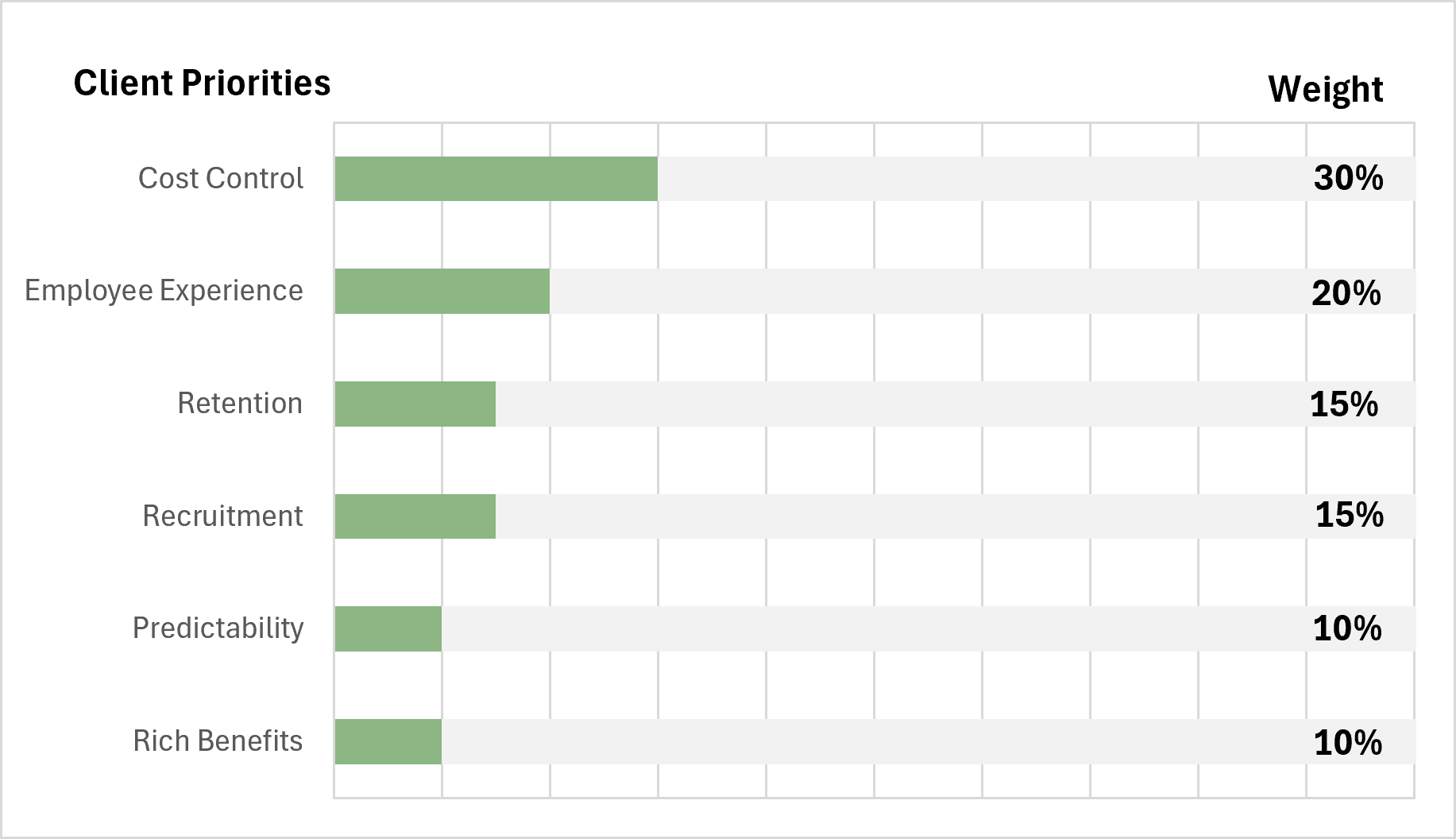
Your priorities Shape The Analysis
Every organization values different things.

Some prioritize controlling costs.

Others are competing for talent, managing turnover, or trying to bring more predictability to a budget that feels impossible to forecast.

Rather than applying the same formula to every client, we ask employers to tell us what matters most.Those priorities influence how different plan options are evaluated and compared.Because the best plan for one employer may be completely wrong for another.
Your priorities, you decide the weights.
Modeling
We Compare More Than Premiums
When evaluating benefit options, we look beyond the monthly rate.
We model how different plan designs affect the full picture:
Employer cost
Employee contributions
Deductibles
Copays
Out-of-pocket exposure
Funding arrangements
Overall plan value
A lower premium is not always a lower-cost plan.
Transparency
We Show Our work
Recommendations should be understandable.
We believe employers should know why one option was recommended over another.
That means explaining the tradeoffs, highlighting the strengths and weaknesses of each option.
No black boxes.
No sales pitches.
No "just trust us."
Just a clear explanation of the data, the analysis, and the reasoning behind every recommendation.
Outcome
Better Data. Better Insight. Better Decisions
Our goal is not to tell employers what to do.
Our goal is to provide the information, analysis, and context needed to make confident decisions. When employers understand their options, they make better decisions for their organizations and the employees who depend on them.

That confidence is what the process is designed to deliver.
Contact us

Discuss your business and aspirations with us.